
Direct volume rendering
Front-to-back emission-absorption ray marching written as TSL node graphs for WebGPU, with early ray termination and per-pixel jitter against banding.
Proprietary volume rendering engine
Lumivox is D/Vision Lab's own volume rendering engine for CT and MR. It ray-marches the whole 3D dataset on the GPU, in real time, on top of three.js and TSL: correct voxel spacing and patient orientation, windowing, transfer functions, clipping and DICOM series, with nothing to install.
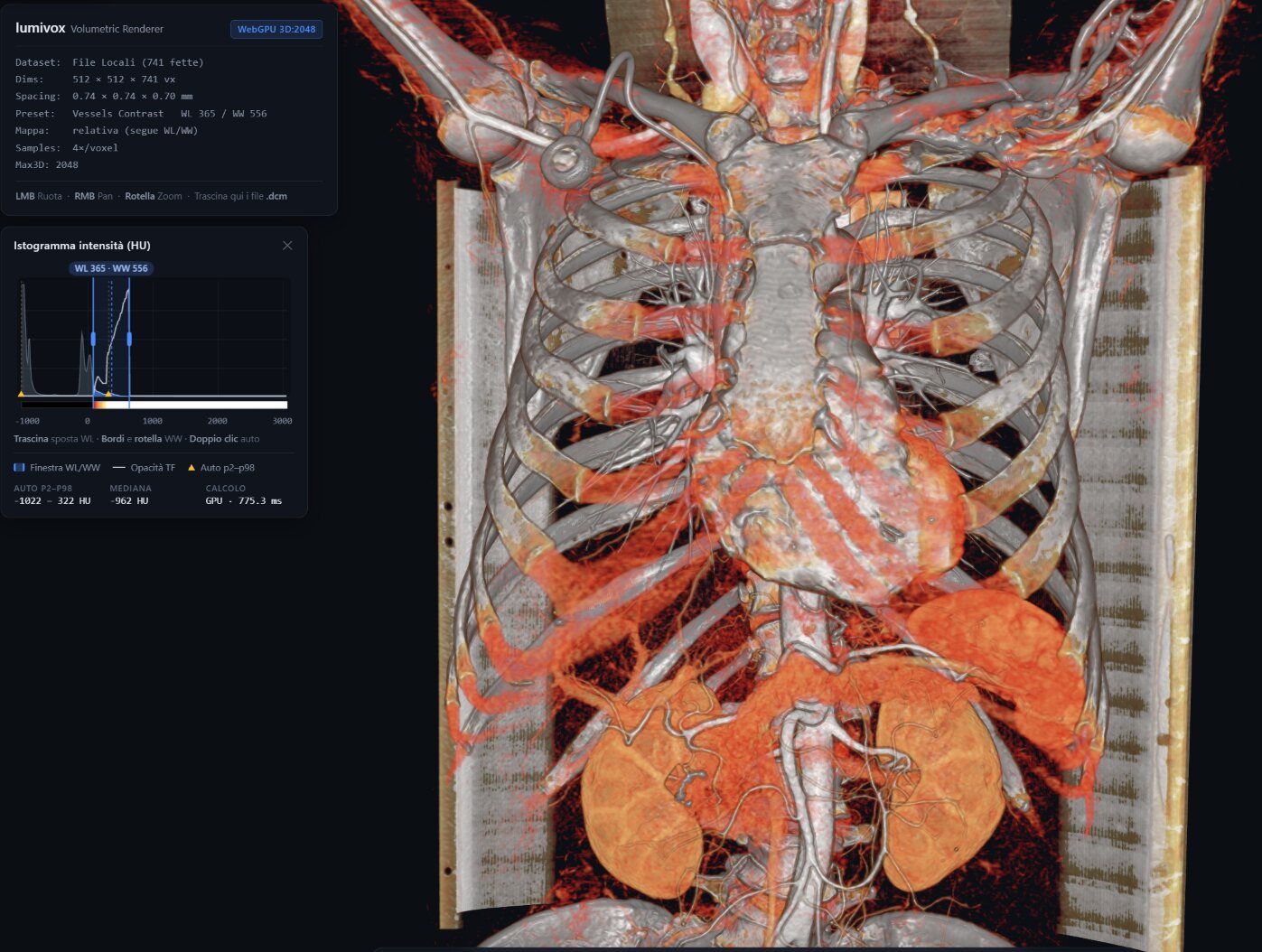
DICOM series from a folder or by drag and drop, nested folders included: spatial sorting, spacing and orientation are read from the files.
Direct volume rendering by GPU ray marching, with windowing, transfer functions and gradient shading.
Ready-made presets, window/level, colormaps, clipping planes, a region-of-interest sphere and an automatic window from the histogram.
One engine, running on the GPU in the browser: no plugin and no server-side rendering.
Front-to-back emission-absorption ray marching written as TSL node graphs for WebGPU, with early ray termination and per-pixel jitter against banding.
Anisotropic voxel spacing and the full affine are respected, and patient orientation (LPS) is never flipped silently. The step size is in millimetres.
Hounsfield units with window width and level, plus 1D transfer functions and CT, MR and angiography colormaps that update in real time.
Normals computed on the fly from the data, with a headlight Blinn-Phong model and thresholds relative to the window to keep noise dark.
Up to six world-space clipping planes and a spherical region of interest with a feathered edge, cut analytically along each ray.
Volumes are regular three.js meshes. Opaque geometry in the scene can occlude the volume, so surfaces and volumes live together.
A WebGPU compute pass scans the volume and suggests a window and level, even on very large series.
From slices to pixels, without leaving the browser.
Raw voxels (8 or 16 bit, Hounsfield units for CT) with spacing and an affine in patient space.
A 3D texture sized to the volume, with exact values for the usual CT range.
One ray per pixel, stepped in millimetres, composited front to back with a transfer function.
The result blends with the rest of a three.js scene and responds to windowing and clipping live.
Status and roadmap. Lumivox is in active development (pre-release). On the roadmap: maximum and minimum intensity projections, 2D transfer functions, volumetric shadows and empty-space skipping. Rendering needs a browser with WebGPU.
Add interactive 3D volume views to a web imaging application.
Explore CT and MR datasets in 3D, without installing anything.
Window, clip and inspect volumes in the browser, and share the tool with colleagues.
Tailored 3D viewers built by D/Vision Lab on top of the engine.
Not for diagnostic use. Lumivox is a visualization engine. It is not a certified medical device and must not be used for diagnosis, treatment decisions or any clinical purpose.
Lumivox is a proprietary volume rendering engine by D/Vision Lab. It renders CT and MR volumes in the browser with direct volume rendering on WebGPU, built on three.js and its Three Shading Language (TSL).
Any browser with WebGPU enabled. There is no WebGL fallback: the renderer is written for WebGPU, and the demo tells you if your browser does not support it.
No. DICOM files are read and rendered locally in your browser. The demo only collects anonymous technical information (volume size and spacing, timings, GPU) and never DICOM tags or file names; you can opt out with the telemetry toggle or by adding ?telemetry=0 to the URL.
Yes. Voxel spacing and the affine transform are part of the data model, the ray step is expressed in millimetres, and the orientation is preserved rather than flipped.
No. Lumivox is proprietary and is not distributed as a library. If you want 3D volume rendering in your project, contact D/Vision Lab and we will see how we can work together.
No. It is not certified and is not for diagnostic use. It is a visualization engine and must not be used for diagnosis, treatment decisions or any clinical purpose.
Lumivox is proprietary and is not distributed as a library. Tell us what you want to build and we will see how we can work together.